What Did Darby See?

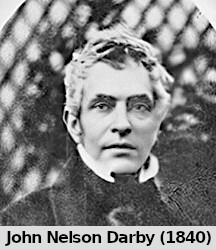
As you may know, people who revile the doctrine of the pre-tribulation Rapture frequently resort to pinning what they view as a heretical doctrine on John Nelson Darby (1800–1882), an Anglo-Irish minister that they claim swiped the idea from the celebrated vision of a 15-year-old Scottish girl named Margaret MacDonald in 1830.
As I have discussed on various occasions over the years, however, this is simply not the case. Not true, never happened. End of story. And this can be readily established by historical writings of the period.
Not to mention the inconvenient fact that several statements Margaret MacDonald made in her vision blatantly contradict a pre-trib scenario.
Oops. But one thing I had never done (although I had long been tempted to) was to closely examine exactly what Darby was thinking in late 1827, while he was convalescing from a riding accident in which a startled horse crushed his leg against a doorpost—a convalescence that extended from about October 1827 to January 1828 according to reliable sources. Be aware, however, that a surprising number of people place it one year earlier, from October 1826 to January 1827—as did I until I did some research for this article.*
*Note: The later October 1827 to January 1828 date is based on a number of very reliable, independent sources, while the earlier, oft-quoted date of October 1826 to January 1827 is based on one misdated letter that was in possession of the Plymouth Brethren, the group Darby co-founded in 1825. According to some, the Plymouth Brethren ended up pushing the highly questionable earlier date in order to maximize the length of time between Darby's revelations and other Rapture-related revelations that came out in the next few years. Anyway...trust me on this one: Go with the later '27–'28 date.
But either way, the injury was a very serious one and it left Darby with a noticeable limp for the rest of his life.
Darby later wrote that in 1827 the Holy Spirit revealed several key scriptural truths to him that led him very naturally to the point where he could see that the Rapture of the Church must logically precede the Tribulation.
In other words, according to his writings:
While he could do nothing but lie in bed and study the Word, God revealed to him several key truths from Scripture that, taken together, pointed him in the direction of a pre-trib view of the Rapture.
Now, understand that John Nelson Darby was, if nothing else, an eminently meticulous theologian. He didn't slap everything together overnight into one slick, pre-trib package. He didn't run down the street in 1827 excitedly telling everyone that he was 100 percent certain that the Rapture had to come before the Tribulation! (Well...he was bedridden, but you know what I mean.)
Not even close. Darby continued to pore over it and study the Word, and over the next several years he fleshed it out and crafted it into a scripturally sound, more fully developed doctrinal teaching that lays key end-time events out in a specific, scripturally logical order. In his later writings, however, Darby pinpoints the period during which he was convalescing in 1827 as when God revealed to him several scriptural truths that led him to the doorstep of the pre-trib view of the Rapture, and which caused him to begin to give shape to that particular end-time doctrine.
But that leads to the question that had intrigued me for years, but I had never gotten around to doing the detective work...until I decided to sit down and work on this article, that is:
What exactly did God show Darby in 1827 that caused him to begin to see the truth of the pre-tribulation Rapture, and that got him started developing it into a more mature doctrine?
In other words, back in 1827...

And I can tell you one thing right now:
Most of the answer merely confirmed
what I already believe, either from my
own study or the teaching of others.
But part of it was quite a surprise.
But before we get into the insights the Holy Spirit revealed to Darby in 1827, let's dispense with one rankling issue once and for all.
Adiós, Maggie!
I want to take a moment to go ahead and get this nonsense out of the way before we get to the meat of the article, and it's something I sincerely wish every post-tribber out there would read. Most of them would probably have a contrived reason for insisting I'm totally wrong, but I honestly don't care.
In the spring of 1830, 15-year-old Margaret MacDonald had been suffering from what is believed to be tuberculosis for the previous two years and was bedridden with it (and I have read that she was so adversely affected by her condition at that time that she would sometimes become delusional). And this is when she had her so-called vision. It got passed around to a number of ministers, and it was ultimately published in 1840 (the same year she passed away at the age of 25). And ever since then, post-tribbers have descended upon it and done their best to pass it off as portraying a pre-trib Rapture.
According to their story, as soon as her vision started making the rounds, John Nelson Darby got wind of it and began palming it off on a naive, unsuspecting Church as the "secret" pre-trib Rapture that would enable wimpish believers to escape the slightest wisp of persecution during the future Tribulation.
To the suprise of no one, there were also "slightly edited" versions of her vision being passed around with a few inconvenient passages altered (if not deleted)...passages that stated a few problematic items such as the following:
• Her original transcript explicitly states that the Church will go through a "fiery trial," and in the given context this is almost certainly a reference to the Tribulation and its associated judgments.
• Her original transcript states that the Church will be "purged by the Antichrist." No, for two reasons: (a) The Church's "purging" occurred at the cross, and (b) Satan's man doesn't purge anyone until during the Tribulation. Before that, he's just a charismatic peace-maker rising in world prominence.
• Her original transcript only describes one single coming of Christ for purification and judgment during (after??) the Tribulation—not a two-part event in which He comes to take the Church out of the world prior to that judgment, and afterwards returns with the glorified Church to establish the kingdom (as espoused by the pre-trib doctrine). Thus, her vision would seem to describe a post-trib (or possibly pre-wrath) Rapture, but it is so unclear and ambiguous that it's difficult to say. In fact, there's only one thing about it that is clear:
It does not describe a pre-trib Rapture.
The bottom line is this:
The original version of Margaret's
vision emphasizes preparation and
suffering through judgment, rather
than preemptive removal from it.
And "preemptive removal from judgment" is an apt description of the blessed hope Scripture clearly promises the Church.
Not only that, but as we will discuss in greater depth in the remainder of this article, Darby documented in his later writings that he began to see the basic scriptural logic of the Rapture preceding the Tribulation in late 1827. Margaret MacDonald had her vision about two and a half years later in early 1830. So the timing renders the claims of post-tribbers at best implausible, and at worst a flat-out lie designed to poison and undermine the teaching of the hated pre-tribulation Rapture.
For the record, it appears John Nelson Darby actually met Margaret MacDonald in 1830. He reportedly visited her while he was in Port Glasgow investigating the outbreak of wild charismatic phenomena within the denomination Margaret was associated with. He concluded (as did a number of other prominent ministers in the region) that this outbreak of charismatic activity was at best excessive and unscriptural, and at worst demonically inspired.
And Darby reached essentially the same conclusion in regard to Margaret MacDonald's vision, and so felt obligated to denounce the whole mess.
But the point is that what transpired between Darby and MacDonald was not her filling his head with glowing images of a pre-trib Rapture, something that was tantalizingly new to him.
The bottom line is that in regard to the development of the doctrine of the pre-tribulation Rapture, I have only one thing to say to our dear Margaret MacDonald and her celebrated vision:
Adiós, Maggie!
And feel free to take that "vision" of yours with you.
What Darby saw...
It strikes me that it's easy for modern believers to look back in retrospect at early developers of various biblical doctrines and think things like...
"Duuh! Didn't they see that A obviously has to happen before B?!"
Although it may be "obvious" to us today, the simple answer is...
No, it wasn't so obvious to them why A had to happen before B.
And the reason is simple—we tend to forget one fundamental truth:
They may have just begun to understand the realities of A and B...the precise temporal relationship between A and B may have represented an additional layer of complexity that took time to iron out.
Today, we have thoroughly developed and scripturally researched doctrines served up to us on a silver platter by capable Bible teachers. In other words, we are lucky enough to enjoy the benefits of centuries of intense, in-depth study of God's Word by legions of men who dedicated their lives to such study.
And John Nelson Darby just
happens to be one of them.
And we certainly run into some of this "A before B" sort of thing when we talk about what Darby began to see in 1827 in regard to the doctrine of the pre-tribulation Rapture. In 1827, Darby was just beginning to see (that is, God was just beginning to show him) some of the foundational principles that he would later fit together more precisely and in a more scripturally supported manner with the help of additional study of the Word.
So, it strikes me that one good way to characterize all this is to say that as far as the doctrine of the pre-tribulation Rapture is concerned...
In 1827, the Holy Spirit laid
out several bricks for Darby.

Darby spent the next several
years puttying in the cracks.
Some of these points may sound obvious to us today—but they weren't quite so obvious 200 years ago. In the early nineteenth century, the Church had not yet broken quite as loose from the bondage of the stuffy confines of formal, institutionalized Christendom as it has in the twenty-first.
Be that as it may, however, here are several of the fundamental points God showed Darby in 1827 while he was convalescing from his riding accident, and they are insights that led him to the doorstep of the doctrine of the pre-tribulation Rapture. Many sources lay these out and explain them in slightly different terms, but the following points constitute the gist of what God showed John Nelson Darby in 1827, according to Darby's later writings:
1. The absolute authority of Scripture.
2. Believers are in Christ, and united to Christ in heaven.
3. As a result, the Church has a heavenly calling.
4. Christ is coming to receive His Church to Himself.
5. Israel has an earthly prophetic destiny coming in the future.
6. The Church's heavenly destiny must be distinguished from Israel's future earthly destiny.
So let's consider these points that God showed John Nelson Darby in 1827 that led him to begin to see that the Rapture must precede the Tribulation.
1. The absolute authority of Scripture.
According to Darby, during his several months of recovery from his accident, one of the first things that the Holy Spirit impressed upon him was seemingly simple and straightforward, but profound to the highest degree:
The absolute authority of Scripture.
Of course, like almost any competent minister, Darby had always recognized the Bible as the Word of God. But just like today, in most cases ministers back then had doctrinal positions and interpretations imposed on them by the particular denomination they were formally involved with, rather than their own studied interpretations of what they thought God's Word said and meant.
For example, if someone is an Assemblies of God minister today, they are obligated to teach that the miraculous sign gift of speaking in tongues that was in full operation 2,000 years ago is still in operation today. That's how that denomination reads and interprets Scripture (and I only know this because that's the church my family attended when I was a kid).
So the first thing God wanted to do was set Darby free from all that so it would be easier to "show him a few things" without having those things forced to pass through some man-made denominational filter. Darby later wrote:
An accident happened which laid me aside for a time; my horse was frightened and had thrown me against a door-post. During my solitude conflicting thoughts increased; but much exercise of soul had the effect of causing the scriptures to gain complete ascendancy over me [...and over whatever theological system he had been trained under]. I had always owned them to be the word of God. [Inspiration wasn't the issue...it was ascendancy.]
(emphasis & [comments] added)
— The Writings of J.N. Darby: Letters, vol. 3, #226 [Source]
This "ascendancy of Scripture" attitude made it easier for Darby to simply study the Word and see things in it that he had previously failed to see.
And he had certainly never seen the pre-trib Rapture in the Word before.
2. Believers are in Christ, and united to Christ in heaven.
One fundamental thing the Holy Spirit impressed upon Darby in 1827 was the simple fact that every born-again believer is in Christ. So we are, in a very real sense, united with Christ in heaven. Darby wrote:
When I came to understand that I was united to Christ in heaven, and that, consequently, my place before God was represented by His own, [in other words, the place Christ occupies is where we will be soon and very soon] I was forced to the conclusion that it was no longer a question with God of this wretched "I" which had wearied me during six or seven years, in presence of the requirements of the law. It then became clear to me that the church of God, as He considers it, was composed only of those who were so united to Christ, whereas Christendom, as seen externally, was really the world, [that is, the organizational, establishment "church" (the RCC, et al.) was in reality just part of a lost world] and could not be considered as "the church"...
(emphasis & [comments] added)
— The Writings of J.N. Darby: Letters, vol. 3, #226 [Source]
The Holy Spirit impressed upon Darby that true believers are in Christ, and that this did not include much of what Darby referred to as "Christendom."
Or what I like to call "Churchianity."
Of course, the fact that believers are "in Christ" wasn't a radically new idea in Darby's day any more than it is today. We see this in a number of places in the New Testament. For example:
11Thus consider yourselves also to be dead to sin, but alive to God in Christ Jesus our Lord.
(Romans 6:11 / emphasis added)
Darby also described it thusly:
I was in Christ, accepted in the Beloved, and sitting in heavenly places in Him...This led me directly to the apprehension of what the true church of God was, those that were united to Christ in heaven.
— The Writings of J.N. Darby: Letters, vol. 1, #308 [Source]
The point is that the Holy Spirit gobsmacked Darby with it because this was arguably the first step along a doctrinal journey He was leading him on. He made Darby see that the place Christ occupies is where believers are spiritually now, will be physically in the future, and it is where we will always be. Christ is currently in heaven, and that's where we're going to be soon and very soon.
3. As a result, the Church has a heavenly calling.
So the Church has a heavenly position because it is united with a heavenly Christ. And this leads us very naturally to another point the Holy Spirit brought to Darby's attention.
The Church has a heavenly calling.
Since believers are united with a heavenly Christ, we are in effect His body, and as a result we have a heavenly calling or destiny.
The Holy Spirit brought passages such as these to Darby's attention:
3Blessed be the God and Father of our Lord Jesus Christ, who has blessed us with all spiritual blessings in heavenly places in Christ: 4According as he has chosen us in him before the foundation of the world, that we should be holy and without blame before him in love:
(Ephesians 1:3–4 AKJV / emphasis added)
2Set your affection on things above, not on things on the earth. 3For you are dead, and your life is hid with Christ in God. 4When Christ, who is our life, shall appear, then shall you also appear with him in glory.
(Colossians 3:2–4 AKJV / emphasis added)
And the Holy Spirit used such passages to lead Darby to reason that the Church's proper position is heavenly, and as a result the Church's calling or destiny is centered on heaven, not earth. As a result, Darby began to see that, as a rule, Bible prophecy focuses primarily on the earthly future of Israel, not the heavenly future of the Church. As Darby puts it:
At the same time, I saw that the Christian, having his place in Christ in heaven, has nothing to wait for save the coming of the Saviour, in order to be set, in fact, in the glory which is already his portion in Christ.
(emphasis added)
— The Writings of J.N. Darby: Letters, vol. 3, #226 [Source]
I love that:
The only thing we're waiting for is Jesus!
Which leads us to:
4. Christ is coming to receive His Church to Himself.
So the Holy Spirit began to impress upon Darby that Christ was coming to take His Church to be with Him, and that was the only thing the Church had to look forward to. For example:
1Let not your heart be troubled: you believe in God, believe also in me. 2In my Father's house are many mansions: if it were not so, I would have told you. I go to prepare a place for you. 3And if I go and prepare a place for you, I will come again, and receive you to myself; that where I am, there you may be also.
(John 14:1–3 AKJV / emphasis added)
Darby mentions the fact that Christ was coming to take the Church to be with Him in heaven in different places in several letters:
I saw in that word the coming of Christ to take the church to Himself in glory.
– The Writings of J.N. Darby: Letters, vol. 3, #226 [Source]
This is extremely important, because here Darby wasn't just saying that Christ would return—he was saying that Christ would return for the sole purpose of taking the Church to be with Him in heaven.
Along the same lines, Darby also wrote:
The coming of the Lord was the other truth which was brought to my mind from the word, as that which, if sitting in heavenly places in Christ, was alone to be waited for, that I might sit in heavenly places with Him.
— The Writings of J.N. Darby: Letters, vol. 1, #308 [Source]
This is part of the root idea behind the imminent, "any-moment" appearance of Christ in the clouds to remove both living and deceased Church Age believers from earth and take them to be with Him in heaven:
The Rapture.
5. Israel has an earthly prophetic destiny coming in the future.
Although Darby saw that the only thing the Church had to wait for was to be translated to heaven in the Rapture, God's people Israel had some very different things to look forward to here on earth. Another key part of what Darby saw in 1827 focused on Israel, and God's prophetic plans for His covenant people in the end times.
One important thing God showed Darby during his convalescence was what the prophet Isaiah describes in chapter 32, which is a future earthly "dispensation" that awaited Israel:
Isaiah xxxii. brought me to the earthly consequences of the same truth...but I saw an evident change of dispensation in that chapter, when the Spirit would be poured out on the Jewish nation, [Isa. 32:15] and a king reign in righteousness. [Isa. 32:1]
(emphasis & [comments] added)
— The Writings of J.N. Darby: Letters, vol. 1, #308 [Source]

A bolt from the blue: This was a total surprise for me—when I first saw Darby's reference to Isaiah 32, seriously...I was like "Isaiah what?!"
In 1855, nearly three decades after God showed him these things during his convalescence, Darby described it this way:
In my retreat [i.e. his recovery from his accident], the 32nd chapter of Isaiah taught me clearly, on God's behalf, that there was still an economy to come, of His ordering; a state of things in no way established as yet. The consciousness of my union with Christ had given me the present heavenly portion of the glory, whereas this chapter clearly sets forth the corresponding earthly part.
(emphasis & [comments] added)
— The Writings of J.N. Darby: Letters, vol. 3, #226 [Source]
In the same letter, Darby confides that he didn't immediately put all the pieces God was showing him in 1827 together at that time:
I was not able to put these things in their respective places or arrange them in order, as I can now; but the truths themselves were then revealed of God, through the action of His Spirit by reading His word. [Note that Darby freely admits he didn't have all the pieces the Holy Spirit had shown him put together back in 1827...it took him several more years of study to work out the details of the whole scenario.]
(emphasis & [comments] added)
— The Writings of J.N. Darby: Letters, vol. 3, #226 [Source]
But God had given Darby the primary bricks he needed. And one of the most crucial bricks is the final point:
6. The Church's heavenly destiny must be distinguished from Israel's future earthly destiny.
Here is where the bricks finally began to fit together in a more logical manner. Darby saw that the Church has a heavenly destiny or calling, and that Israel has a future earthly destiny as described in Isaiah 32. In other words, Darby was seeing two distinct spheres of activity:
Heavenly: Christ and the Church.
Earthly: Israel and her promised kingdom.
Concerning his perception of these two spheres of activity, Darby wrote:
I am daily more struck with the connection of the great principles on which my mind was exercised by and with God, when I found...the church as His body; Christ coming to receive us to Himself; [the Rapture] and collaterally [see remarks below] with that, the setting up of a new earthly dispensation, from Isaiah 32 (more particularly the end); [Israel's promised kingdom] all this was when laid aside at E.P.'s in 1827. ["E.P." is Edward Pennefather, Darby's brother-in-law who lived about 30 miles from Dublin, at whose home Darby spent most of his convalescence.]
(emphasis & [comments] added)
— The Writings of J.N. Darby: Letters, vol. 1, #206 [Source]
Note Darby's use of the word "collaterally" in the above quote. The suggestion is that he remembered these two truths together: (a) the Rapture, and (b) Israel's earthly prophetic destiny, which includes their kingdom ruled by Christ as described in Isaiah 32.
It seemed incongruous to
Darby to have a heavenly
Church still on earth while
Israel was being groomed
for its earthly kingdom.
But since God had led Darby to see that the Church had a heavenly destiny and had nothing to wait for except the Rapture—and that Israel's prophetic destiny was earthly, Darby began to see that Israel's future destiny of judgment followed by the establishment of a kingdom ruled by Christ should logically follow the Rapture. In other words, you might say...
It seemed incongruous to Darby to have a heavenly Church still on earth while Israel was being groomed for its earthly kingdom.
As a result, Darby began considering the idea that these events must belong to different end-time phases or segments. Following these revelations he received from God during his convalescence in 1827, Darby was faced with the following series of bricks:
• The Church has a heavenly destiny, and Israel an earthly destiny.
• Christ comes to remove His heavenly Church.
• God's earthly destiny for Israel resumes.
• With the heavenly Church removed, Israel's earthly destiny plays out.
Although this presents us with the fundamental architecture of the pre-trib doctrine, suffice to say that Darby still had a few cracks to putty in.
So, again...an important caveat:
Not so fast: Again, we have to be careful and avoid saying that in late 1827, Darby saw the whole "pre-trib Rapture, seven-year Tribulation, Second Coming of Christ to launch the Millennial Kingdom" prophetic panorama all worked out in scriptural detail. By his own testimony, he did not, at least not yet. Many of the details and the systematic ordering of things took him several more years of study to iron out with confidence and scriptural certainty.
One useful way of looking at Darby's thinking that resulted from what God showed him in 1827 is as follows:
Darby wasn't simply asking "When does the Rapture happen according to some prophetic timeline?" He began reasoning more along the following lines:
Q. What is the Church's calling?
A. Heavenly.
Q. What does the Tribulation deal with?
A. Israel's earthly destiny, which includes God's judgment followed by their promised kingdom ruled by Christ.
Q. Will the Church remain on earth to pass through that period?
A. No. Why should it? How are these compatible? The Church must be removed to heaven before God's earthly prophetic program for Israel resumes—a program that includes God's judgment on both Israel and the world prior to the establishment of Israel's promised kingdom. Of course, the Church will return with Christ to play a role in that kingdom, but that's a different issue.
People who hold views that place the Church in the Tribulation need to explain why the Church needs to be subjected to judgments expressly aimed at Israel and a fallen world that has persecuted God's people. Just a reminder:
We've come a long way, baby!
Before I close, I want to point out that due primarily to the fulfillment of prophecy that we have witnessed over the years, we have come a long way in our understanding of the end-time scenario since 1827, when God showed Darby these few precepts that led him to see the logic of a pre-trib Rapture.
Today, most people who have a clear, scripturally informed grasp of the end-time scenario take the fact that the Rapture comes before the Tribulation as a virtual given. Why? Simple:
Because they know that no other view
makes as much scriptural horse sense.
I'm not trying to sound like some sort of biblical know-it-all (which I'm not—there is plenty I don't know), but if someone cannot at the very least see that the Rapture simply must occur before the launching of the Tribulation for a host of clear, compelling scriptural reasons, they are missing a step or three in what the Bible clearly teaches about the end-time scenario.
And it saddens me to say it, but today's Church is filled with people who miss considerably more than a step or three in that regard.
These days, well-tuned watchmen are more likely to discuss somewhat more obscure, detailed points, such as the relative timing of the attack of Gog-Magog, the ethnic background of the man who will become the Antichrist, and so on and so forth. For such people, the fact that the Rapture occurs prior to the Tribulation is like "Well...yeah." In other words...
For scripturally informed watchmen today,
most of the points we've discussed in this
article constitute rock-bottom basic stuff.
But they are still of critical importance.
All I set out to do in this article was to give you some insight into what God showed John Nelson Darby back in 1827 that led him to see the truth of the pre-trib Rapture, that's all. But I'm pleased to report that dedicated, scripturally informed watchmen of modern times can look back and truthfully say:
We've come a long way, baby!
'27 or bust
People who adhere to an intra-trib view of the Rapture (post-trib, pre-wrath, whatever) must explain why the Church, which is united with a heavenly Christ, needs to suffer through all or any of the judgments of the Tribulation—judgments that are expressly aimed at His people Israel and a fallen world that has persecuted them, and not the body of Christ. And every single argument from such people I have ever heard falls as flat as a Crêpe Suzette and can be dismantled with a minimal amount of scriptural legwork.
Over the years, I have essentially retired from arguing with those who treat the doctrine of the pre-tribulation Rapture as if it were little more than the lunatic ramblings of a gaggle of tinfoil hatters who are too terrified of the idea of getting a hangnail during Daniel's 70th Week to consider the "truth" of one of their intra-trib views.
And if that steps on a few toes
out there, that's a real shame.
A few years ago I might have said "Hey, bring it," but I've learned the hard way that doing so is a waste of time. So I am perfectly content to refrain from arguments about the timing of the Rapture—it's too late in the game for that, and it just distracts people from more important things.
Speaking of the Rapture, I hope you haven't failed to notice that rantings against the doctrine of the Rapture, particularly of the pre-trib variety, are rising and intensifying in many parts of the Church these days, not to mention the world. Why? That's easy: Satan's been a busy boy.
And when Satan's a busy boy, it's usually worthwhile to take notice.
I almost hate to mention this, because in the last few years I have reached the point where I usually try to politely steer clear of anything that even has the odor of Rapture prognostication. It's not because I think there's anything necessarily wrong with it, mind you—it's just that I totally stink at it.
I mean, I'm no dummy, but when people start talking about the paths and positions of comets and constellations, I just go glassy-eyed.
But as I worked on this article, this whole idea of God revealing to John Nelson Darby a series of insights into the nature of the pre-trib Rapture turned the words "1827" into a little chant I kept hearing in the back of my mind:

And I couldn't help but think that in about three months it will be (drum roll, please...) 2027, the 200th anniversary of Darby's experience of the Holy Spirit giving him these insights into Christ's coming for His Church in the Rapture before the Tribulation and His end-time dealings with Israel during it. And that little chant began to morph into:

And I started wondering if God did anniversaries. And sure enough, the next thing I knew I was getting a whiff of that odor again...
Oh, all right...just this once. Here's a nifty little idea for you: Notice that the number 27 is 33 (i.e. 3 x 3 x 3). The number 3 represents divine completeness, especially in the sense that the Trinity is the completeness of God's person and presence. In the expression 33 it appears as if you have a small portion of God flying up into the clouds, which is more or less what happens at...you know, the Rapture. Sort of. Kinda nifty, huh?
Sigh... OK, back to the real world. So now you know why I tend to avoid Rapture prognostication.
Yeah, yeah, I know...what are the odds, right?
Greg Lauer — OCT '26
If you like this article,
share it with someone!

1. Adapted from Sunset Over Grass Field © AOosthuizen (source defunct)
2. Photograph of John Nelson Darby in Geneva, 1840 (author unknown), marked as public domain [PD], more details on Wikimedia Commons
3. What Did Darby See? by Greg Lauer (own work)
4. "Six separate bricks lying end to end on a wooden table" prompt, image generated by ChatGPT, SEP 24, 2026
5. Big Lightning Over Small Town © I_g0rZh via DepositPhotos
6. Adapted from Jesus Crucified on the Cross at Calvary © alexandarilich85 via DepositPhotos
7. "The words 1827...1827...1827... displayed in an elegant 19th century script with dust and cobwebs" prompt, image generated by Google Gemini, OCT 1, 2026
8. "The words 2027...2027...2027...placed in a modern, high-tech setting" prompt, image generated by Google Gemini, OCT 1, 2026
9. Adapted from 9a–9b:
9a. Click Icon Vector © avastudio via DepositPhotos
9b. "Magnifying glass looking at printed letters ALS" prompt, image generated by DepositPhoto's Nano Banana, JUL 3, 2026
Scripture Quotations:
All Scripture is taken from the World English Bible, unless specifically annotated as the King James Version (KJV) or the American King James Version (AKJV).