The Best and the Brightest


I have a sister who is two years older than me, and all through school she had a well-earned reputation for being one of the wild ones. She didn't study much, got poor grades, had a penchant for the bad boys, and seemed to cause a lot of headaches for her teachers (not to mention her parents).
But then along would come little Greg two years later, and when those same teachers would recognize my last name and realize I was her younger brother, they were inclined to groan and mutter...
"Oh no...not another one!"
But when those teachers discovered to their surprise and delight that I was smart, studious, quiet, well-behaved, and respectful, they adored me and lauded me as being one of the best and brightest in the entire class. To some extent I had them fooled, however. OK, maybe I really was smart, but I was also a borderline Aspie who lived in his own little world—and who was also scared of his father. (I'm no child psychologist, so I have no idea what to make of that...but the fear had dissipated by the time I got to high school.)
What brought those memories to my mind, however, is the fact that this article is about exactly that: The best and the brightest...
Both in the eyes of men and in the eyes of God.
First, a quick glance at the historical events that led up to what we are going to deal with in this article:
In about 930 BC, Israel experienced a major split over who was going to be king after the death of King Solomon. The end result was that 10 of the 12 tribes recognized Jeroboam as king and separated into the Northern Kingdom of Israel, while the tribes of Judah and Benjamin remained loyal to Solomon's son Rehoboam and formed the Southern Kingdom of Judah (which contained Jerusalem).
The Northern Kingdom was conquered and taken over by the Assyrians in about 722 BC. As the Babylonians gained ascendancy over the Assyrians over the course of the next century, however, it finally reached the point where the Babylonian empire sought to subsume Judah and by 605 BC Judah had become their vassal state. That's the year the Babylonians began to deport people from Judah back to Babylon...
And that's where our story begins.
The Judeans began to be hauled off to Babylon under King Nebuchadnezzar, and were ultimately held captive for 70 years—a period commonly known as the Babylonian captivity. By the time the Babylonians were finished with Judah, the city of Jerusalem was left in ruins, along with their magnificent First Temple that had been built by David's son Solomon.
The deportation of the Judeans into captivity in Babylon for 70 years was prophesied by Jeremiah (Jer. 25:11–12; 29:10–14) and others, but this judgment that God unleashed on His people did not occur all at once. This deportation occurred in three major phases in the late seventh and early sixth centuries BC. The third and final phase of that deportation, which was when Jerusalem and the temple were destroyed, occurred about 586 BC.
Obviously, the entire episode of Judah's 70-year Babylonian captivity (seen by some as extending from 607–538 BC, but there are several different views of the details) is of great prophetic significance. In many ways, it serves as a preview of a more expansive 490-year period of judgment foretold by the prophet Daniel near the end of that 70-year captivity known as Daniel's 70 Weeks, the final week of which is the yet future seven-year Tribulation. During that final period of seven years, God will unleash His final round of judgment and bring a remnant of Israel to faith in their Messiah and usher them into their promised kingdom after Christ returns to earth at its conclusion.

Of course, there are a number of parallels between the 70-year Babylonian captivity, Daniel's 70 Weeks, and the culminating 7-year Tribulation, but I will only make passing references to these in this article. That's a sufficiently broad topic that I'm not going to dig too deeply into all of that here because that's not the aspect I want to pursue.
In this article, I want to focus primarily on the first wave of deportation, which occurred in 605 BC. The reason for that is because I want to discuss two specific aspects of that deportation:
1. Exactly who was deported.
2. Exactly why they were deported.
And why might I do that, you ask? Because it is my opinion that this first wave of deportation of Judeans to Babylon has clear prophetic parallels to a very significant future "deportation" of a very different type:
The "deportation" of Church Age
believers to heaven at the Rapture.
As you may know, there are several events in the Old Testament that could be said to foreshadow the translation of the Church at the Rapture. Chief among them is what happened to Enoch, just prior to the Flood:
21And Enoch lived sixty and five years, and begat Methuselah: 22And Enoch walked with God after he begat Methuselah three hundred years, and begat sons and daughters: 23And all the days of Enoch were three hundred sixty and five years: 24And Enoch walked with God: and he was not; for God took him. [God took him. Period. And just for an extra twist, according to ancient rabbinic traditions, Enoch was taken on the sixth of Sivan, or the day on the Jewish calendar that corresponds to Shavuot. We know that day as Pentecost, or the day the Church was conceived.]
(Genesis 5: 21–24 AKJV / emphasis & [comments] added)
I've always enjoyed referring to this as the "pre-Flood Rapture" since it not only prefigures the Rapture itself, but as a bonus it also prefigures the fact that the Rapture occurs prior to the Tribulation.
There's also Lot. Lot was a righteous man, and he and his family were hustled out of Sodom by angels just prior to God's cataclysmic judgment on Sodom and Gomorrah in Genesis chapter 19.
OK, let's get down to business with what happened in this first wave of deportation of Judeans to Babylon.
Exactly who was deported
First of all, let's go to the book of Daniel and review the pertinent Scripture related to this initial wave of deportation by the Babylonians:
1In the third year of the reign of Jehoiakim king of Judah, Nebuchadnezzar king of Babylon came to Jerusalem and besieged it. 2The Lord gave Jehoiakim king of Judah into his hand, with some of the vessels of the house of God; and he carried them into the land of Shinar to the house of his god. He brought the vessels into the treasure house of his god.
3The king spoke to Ashpenaz, the master of his eunuchs, that he should bring in some of the children of Israel, even of the royal offspring and of the nobles: 4youths in whom was no defect, [some translations read "handsome"] but well-favored, skillful in all wisdom, endowed with knowledge, understanding science, and who had the ability to stand in the king's palace; [i.e. the best and the brightest] and that he should teach them the learning and the language of the Chaldeans. 5The king appointed for them a daily portion of the king's delicacies and of the wine which he drank, [more on this below] and that they should be nourished three years, that at its end they should stand before the king. 6Now among these of the children of Judah were Daniel, Hananiah, Mishael, and Azariah. [These are their Hebrew names.] 7The prince of the eunuchs gave names to them: to Daniel he gave the name Belteshazzar; to Hananiah, Shadrach; to Mishael, Meshach; and to Azariah, Abednego. [And these are their Babylonian names—see remarks below.]
(Daniel 1:1–7 AKJV / emphasis & [comments] added)
The first issue is exactly who was taken in this initial wave of deportation to Babylon. The Babylonians would ultimately take them all, but this first wave was special in certain ways.
As you read verse 4, one thing is clear: In this first wave of deportation...
The Babylonians wanted
the best and the brightest.

(Hmm...great idea for a title.) In this first wave, the Babylonians were only interested in taking the elite along with their attractive, intelligent, and talented young people back to Babylon. Their ultimate goal may have been enhance their nation's power and status by grooming these young, shining stars into people who would some day make significant contributions to their nation, and they left all the common folks behind to suffer on their own (and to be deported at a later point in time).
What's in a name: As I mentioned above, Daniel, Hananiah, Mishael, and Azariah were the four boys' Hebrew names. In Babylon, however, they were given the Babylonian names of Belteshazzar, Shadrach, Meshach, and Abednego, resp. It is a bit ironic that throughout Bible-related literature, Daniel is invariably referred to by his Hebrew name of Daniel—never his Babylonian name of Belteshazzar...which typically draws blank stares from most believers. His three friends, however, are far better known by their Babylonian names of Shadrach, Meshach, and Abednego. If you call his pals by their Hebrew names of Hananiah, Mishael, and Azariah, most people have no idea who you're talking about (which was long the case for this writer, if I'm being honest).
Notice also that, unlike most cases where people are forcibly dragged off to a foreign land far from their home, we see in verses 4 and 5 above that these captives in the first wave were actually very well treated. They had excellent living quarters, were very well fed, prodigiously educated, and many ultimately served as attendants in the king's court. For all intents and purposes:

Daniel and his friends may as well have been the sons of a king.

They were treated with a surprising level of respect and consideration, unlike what most captives could expect in the majority of such cases. We see an example of this in verse 5 above, where Daniel rejects the food and drink they were offered (food and drink that most people would consider fine dining), and what transpired afterwards:
8But Daniel purposed in his heart that he would not defile himself with the king's delicacies, nor with the wine which he drank. Therefore he requested of the prince of the eunuchs that he might not defile himself. [This makes it obvious that Daniel and his friends were not being treated the way deportees might typically be treated: They were being served the finest food—the king's food, no less. And then Daniel had the incredible audacity to ask for something different.] 9Now God made Daniel find kindness and compassion in the sight of the prince of the eunuchs. [As always, God has His hand on the throttle.] 10The prince of the eunuchs said to Daniel, "I fear my lord the king, who has appointed your food and your drink. For why should he see your faces worse looking than the youths who are of your own age? Then you would endanger my head with the king." 11Then Daniel said to the steward whom the prince of the eunuchs had appointed over Daniel, Hananiah, Mishael, and Azariah: 12"Test your servants, I beg you, ten days; and let them give us vegetables to eat and water to drink. 13Then let our faces be examined before you, and the face of the youths who eat of the king's delicacies; and as you see, deal with your servants."
14So he listened to them in this matter, and tested them for ten days. [And they got exactly what they asked for.] 15At the end of ten days, their faces appeared fairer and they were fatter in flesh than all the youths who ate of the king's delicacies. 16So the steward took away their delicacies and the wine that they were given to drink, and gave them vegetables.
(Daniel 1:8–16 / emphasis & [comments] added)
"Hold up, Bible Dude...lemme get this straight: You're trying to tell us that Daniel, Shadrach, Meshach, and Abednego are a type of the raptured Church because...why? Because they got deported to Babylon and were served fancy food...oh, and this was before the destruction of Jerusalem? If anything, they gotta be the Jewish remnant!! We're not that dumb!"
OK, time out. That reminds me of something I want to put out there, because I don't want anyone to come away with the wrong idea:
In this article, I am not saying that Daniel, Shadrach, Meshach, and Abednego directly and fully represent the Church throughout the book of Daniel. They don't. I am focusing primarily on the simple fact that they were removed from the scene of God's devastating judgment before that judgment fell...and how such an event can paint a typological picture of the removal of the Church from earth prior to the Tribulation.
Which calls something to mind: We sometimes have to tread lightly with types and foreshadowings because they can vary in depth and contextual applicability. For example, if I were to sit here and try and tell you that Daniel, Shadrach, Meshach, and Abednego represent the Church in the entire book of Daniel, then anyone with any sense would do well to ask:
"Oh, really? Well, then what gives with chapter 3?!"
I've discussed this on several occasions, but in Daniel chapter 3 we see Shadrach, Meshach, and Abednego being tossed into the furnace for refusing to worship the golden statue set up by King Nebuchadnezzar (a type of the Antichrist), and Daniel is never mentioned. A fourth man whom the king says looks like the Son of God appears in the furnace with them, and protects them. I believe the appearance of that fourth man is a Christophany, and that this scene is a foreshadowing of the believing Jewish remnant being protected by God during the Great Tribulation.
You're right...you'd have to be dumb to assume Shadrach, Meshach, and Abednego represent the Church in chapter 3, no matter what happens in chapters 1 and 2. But here's the point: Nothing prevents us from viewing the event of their deportation from Jerusalem prior to its utter destruction as a picture of the Rapture—because it clearly is. That means that at least in the context of that event the boys could legitimately be viewed as a picture of the raptured Church. So the best way to interpret types is to just "play it as it lays." And I never said you were dumb. OK, game on.
Although the treatment of Daniel and his friends in Babylon certainly pales in comparison to what we will experience after our translation to heaven at the harpazo, a fundamental truth still shines through:
When we get to heaven after the Rapture,
we really will be treated like royalty.
Actually, better. According to the apostle Paul, what we experience when we get to heaven after the Rapture is literally beyond our imagination:
9But as it is written, Eye has not seen, nor ear heard, neither have entered into the heart of man, the things which God has prepared for them that love him.
(1 Corinthians 2:9 AKJV)
And why is that? Because we are royalty! Certainly not in the human or fleshly sense, no. But in God's eyes?
We are the adopted sons and daughters
of the Creator, the King of the Universe!
Please...let that sink in for a moment.
Down here on earth during our earthly lives, we are all still sinners with a sin nature. In one sense, we have nothing on other people in the world: followers of all manner of false religions, atheists, agnostics, people who don't give a rat's patootie...you name it. Many of us were just as foolish and deceived. We were just as dismissive of God and His Word as anyone else, if not more so.
The only difference between us and the people of the world who are bound for an eternity of separation from a loving God is that at some point in our lives we responded to the conviction of the Holy Spirit—conviction that made us realize we were sinners separated from God, and we believed in faith in the atoning sacrifice God's Son made on our behalf and trusted Him for the forgiveness of our sin that separated us from our Heavenly Father.
That's it.
And when we did that, we literally became one with Christ, the Son of God, and as a result we became joint-heirs with Christ:
15For you have not received the spirit of bondage again to fear; but you have received the Spirit of adoption, whereby we cry, Abba, Father. 16The Spirit itself bears witness with our spirit, that we are the children of God: 17And if children, then heirs; heirs of God, and joint-heirs with Christ; if so be that we suffer with him, that we may be also glorified together. [That is, being "God's children" isn't a feel-good euphemism that applies to everyone, as the world so naively wishes to believe—it actually means something!]
(Romans 8:15–17 AKJV / emphasis & [comments] added)
But in regard to the best and the brightest that were taken to Babylon in that first wave of deportation: If that bears parallels to the Rapture, then...
• Does that mean that we as believers are the most attractive people on earth?
I wish...
• Does it mean we are the smartest, best educated people around?
Duuh...
• Do we merit special treatment like what Daniel and his friends were shown?
NO!!
Make that an emphatic "NO!!" on all counts. This parallel is strictly in the eyes of God, not the eyes of men. We're not talking about how the world sees us—we're talking about how our Heavenly Father sees us. We're not talking about fleshly things—we're talking about spiritual things.
• In God's eyes, I am His precious adopted son and joint-heir with Christ, and will spend eternity with Him in a place too wonderful for me to imagine.
• In the world's eyes, I'm just another schmuck in the crowd...just one that tends to babble on about all that whacked-out Bible stuff.
So in spiritual terms, it's clear that the first wave of deportation of Judeans to Babylon in 605 BC does in fact bear a clear parallel with the catching away of the Church in the Rapture. But stand by...
That's not the only parallel out there.
Exactly why they were deported
Another clear parallel between the first wave of deportation of Judeans to Babylon and the Rapture lies in the reason why they were deported.
In about 589 BC, the Babylonians planned to finally come and take most of the remaining people of Judah away as captives and destroy Jerusalem...
And they carried out their plan to a T.
Of course, the fact that it was actually God's plan helped out quite a bit.
Yes, God's plan. God's plan was to use the Babylonians as a tool to carry out His judgment on His people. And why did God do that? That's easy, and it basically comes down to one single word:

God had had His fill, and He wanted to cure His people of idolatry once and for all. God had finally had enough of their idols and their worship of false gods and despicable pagan practices that they had picked up during their time of slavery in Egypt, and that they had clung to ever since entering the Promised Land in the late fifteenth century BC (some say the thirteenth). So God's people had effectively been spitting in His face for anywhere from 600 to 800 years or so, continuing with their pagan practices and worshiping a smorgasbord of idols and pagan gods with abandon.
Although there were a number of periods of revival when they would return to God, they would invariably slide back into idolatry after a period of time.
And God finally said:
"Enough is enough."
One good thing: In one sense, God's judgment in the form of the 70-year Babylonian captivity was successful—it did cause God's people to finally put away their false gods and turn from idolatry, which never again flourished among them to any significant degree after they were freed and returned to Judah. However, something almost as bad took its place: turning God's grace and mercy into legalism. What arose in the following centuries was the idea that God considered someone righteous based on their obedience to the Law of Moses. In other words, works-based salvation. So just be aware:
Salvation by works was an error for Old
Testament Jews, and it is still an error
that infects parts of the Church today.
Another reason for this judgment at the hands of the Babylonians had to do with their disobedience of God's instructions in regard to their land.
The Law of Moses required them to let their land lie fallow every seventh year (Lev. 25:4). In other words, once every seven years the land was to have a "Sabbath rest," and no crops were to be sown. So just as the people were to have a day of rest every seven days, the land was to have a year of rest every seven years. This law actually had two purposes:
1. It served as a way to force them to have faith in God's provision and trust Him that they would have sufficient harvests to see them through the year of allowing the land to lie fallow.
2. It had the physical benefit of allowing the land to replenish its nutrients and other natural resources and so remain in good condition indefinitely.
But it wasn't long before obedience to this particular law fell by the wayside, and they began routinely ignoring the land's Sabbath rest every seventh year. And apparently they skipped this Sabbath rest 70 times, or over a period of 490 years (70 × 7). Thus their 70 years of captivity also served as punishment for the 70 times they had disobeyed God's law concerning the land's Sabbath rest (2 Chron. 36:21; Jer. 25:11).
Like I said, the deportation of Judeans to Babylon occurred in stages, with most commentators believing there were three major waves. The first wave occurred in 605 BC and they took the best and the brightest including Daniel and his three friends, as we have discussed. The second wave occurred in 597 BC, and included the prophet Ezekiel. But it's the final destruction of Jerusalem and the temple in 586 BC and the final group of captives that were taken that I want to focus on at this point.
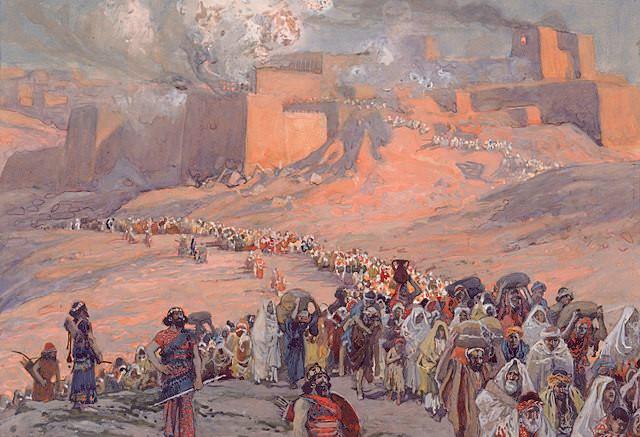
The Babylonians had attacked Jerusalem previously, but in 589 BC they came to finally destroy it and the First Temple and take the final wave of God's people captive back to Babylon. The Babylonians laid siege to Jerusalem for 18 months (same say 30 months), and this siege caused terrible suffering to the population. Finally, in 586 BC, the Babylonians stormed Jerusalem and completely destroyed it, and demolished the First Temple in the process. They took the bulk of the remaining population captive, and this last group of captives trudged off to Babylon with their beloved city of Jerusalem and their cherished temple lying in a pile of smoldering rubble.
Note that the siege of Jerusalem bears clear parallels with the Great Tribulation, during which the Antichrist will hunt down and seek to kill every living Jew after the believing remnant refuses to worship him as God in the flesh following the abomination of desolation at the midpoint of the Tribulation.
• Through Hitler and his henchmen, Satan got one-third of them.
• Through the Antichrist, Satan will get two-thirds of them (Zech. 13:8–9).
But Satan will never get them all—you have God's Word on that.
Satan's stooge: Speaking of Satan's man the Antichrist, we can add King Nebuchadnezzar's name to the list of Old Testament characters who provide a foreshadowing of the Antichrist. And as are the majority of such Old Testament characters (not all, but most), he is a Gentile. Consider: Nebuchadnezzar demanded absolute worship, built a golden image for the people to worship, and killed all dissenters. Similarly, the Antichrist will demand absolute worship as God in the flesh, set up a graven image in the Holy Place to be worshiped, and seek to kill all dissenters.
The point I'm getting at is this:
• The first wave of deportees that included the best and the brightest such as Daniel and his friends occurred well before the final attack on Jerusalem, and the reason God arranged for them to be taken at that point is so they would be spared from His judgment that came in the form of the siege that ended with the destruction of Jerusalem and the temple.
• Similarly, the Church—God's best and brightest spiritually speaking—is raptured prior to the Tribulation because God has promised us in His Word that we will be spared from that terrible time of judgment on Israel and the nations of the world that have persecuted His people.
I believe one reason God arranged for Judah's best and brightest to be spared from His devastating judgment is to paint us a picture of His best and brightest being raptured before the Tribulation and thus being spared His final judgment on Israel and the world during that period.
So when we consider who was (or will be) removed and why in both cases, we see clear parallels between the deportation of Daniel and his friends to Babylon prior to the destruction of Jerusalem and the "deportation" of the Church in the Rapture prior to the judgments of the Tribulation. In my humble opinion...
It's hard to miss.
Straight A's...NOT
Speaking of the best and the brightest, as I worked on this article I fantasized about what it would be like if we were issued report cards in regard to our walk with the Lord, just like what we were given in school.
And I can just see it now:
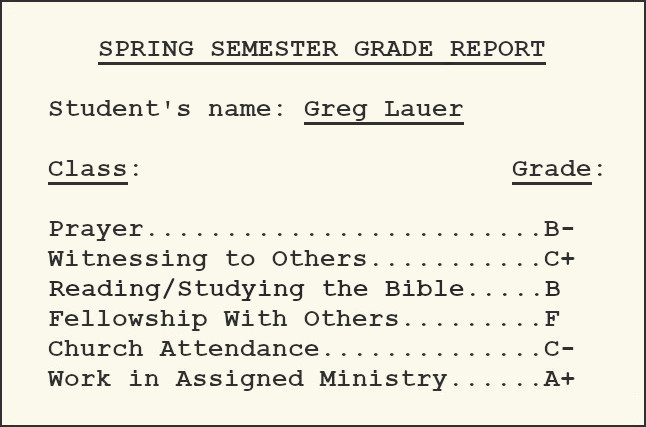
Knowing me, I'd probably need to take remedial versions of certain classes that I was struggling with...
Or repeat ones I flunked.
So there's another fun little project for you: Write your own spiritual report card. This is a great way to contemplate areas where you shine and areas where you might, shall we say, need a bit of work.
But no matter how high or low your spiritual GPA may be (and mine's not exactly gonna get me on the honor roll), please remember one fundamental thing—and this is critical:
If you want to be one of
God's best and brightest, you
don't have to get straight A's.
You just have to get saved by grace.
Saved by grace through belief in faith in what His perfect, sinless Son did for us on a cross two thousand years ago, that is.
Jesus Himself is truly God's best and brightest. And when we place our faith in His sacrifice for the forgiveness of our sin and our reconciliation with the Father, from that moment on we are secure in Christ and God sees us as being as righteous as His Son.
The moment we do that, we have met His primary, overriding requirement...
And that's what makes us
God's best and brightest!
Greg Lauer — JUL '26
If you like this article,
share it with someone!

1. Adapted from Sunset Over Grass Field © AOosthuizen (source defunct)
2. "Small graduating class in the clouds" prompt, image generated by DepositPhoto's Nano Banana, JUN 23, 2026
3. Who? Why? by Greg Lauer (own work)
4. "Four handsome teenage boys in ancient Israel" prompt, image generated by DepositPhoto's Nano Banana, JUN 23, 2026
5. Adapted from Christmas Greeting Card by geralt [CC0], (text added) via Pixabay
6. Steak With Red Wine © chiyacat via DepositPhotos
7. Idolatry by Greg Lauer (own work)
8. The Flight of the Prisoners by James Tissot, marked as public domain [PD], more details on Wikimedia Commons
9. Report Card by Greg Lauer (own work)
10. Adapted from 10a–10b:
10a. Click Icon Vector © avastudio via DepositPhotos
10b. "Magnifying glass looking at printed letters ALS" prompt, image generated by DepositPhoto's Nano Banana, JUL 3, 2026
Scripture Quotations:
All Scripture is taken from the World English Bible, unless specifically annotated as the King James Version (KJV) or the American King James Version (AKJV).