God's 4-H Club


Most Americans have heard of 4-H (Head, Heart, Hands, and Health), which is a youth development program administered under the auspices of both the National Institute of Food and Agriculture and the U.S. Department of Agriculture. I recall they had a 4-H club in the high school I attended in my home town in Central Illinois, which, like 4-H clubs all over America, provided educational opportunities for young people aged 8–18 related to agriculture, healthy living, science and technology, and civic engagement.
Well, that sounds terrific...especially in a highly agricultural area like Central Illinois. But my oh-so-cool friends and I had absolutely zero interest in what seemed to us like a total snoozer—a boring club full of nerdy farm girls.
But I've been studying some things recently in regard to the different ways God blesses people who obey Him and do their best to walk according to His Word that made me realize that in a sense God has His own version of 4-H. Rather than Head, Heart, Hands, and Health, however, God's 4-H club is all hands: It consists of four different sets of hands that He uses to bless people when they strive to live in faithful obedience to Him, and Scripture is replete with examples of all four.
The four different sets of hands through which God blesses believers could be classified as follows:
H-1: Man's hands
H-2: God's hands
H-3: Your enemies' hands
H-4: Your own hands
In this article, I want to consider a few examples of how God blesses people through these four different sets of hands by looking at some applications of all four taken from Scripture.
Although it's true that there are many examples of all four of these scattered all throughout the Bible, as it turns out we can see such examples in one particular scriptural arena. That would be the sequence of events that occurred as God dealt with His people Israel early in their history: establishing them as a nation, allowing them to become slaves in Egypt, delivering them from bondage, and ultimately leading them into the Promised Land.
And you know what that means: That means it's time to gear up for a little round of Old Testament Story Hour.
H-1: Man's hands
One of the premier examples of God blessing someone through man's hands or the hands of other people lies with Joseph, the second youngest son of Jacob and grandson of Abraham.
In Genesis 37, we meet young Joseph, who is favored by his father Jacob. At one point Joseph has two dreams that symbolize his older brothers all bowing down before him, and when Joseph tells his brothers of the dreams all it does is intensify the already bitter feelings of jealousy they harbor toward him. After that, they can scarcely speak to him peaceably.
One time when Joseph's older brothers are off tending the family's flocks of sheep in a region nearby, Jacob sends Joseph off to check on his brothers and see how things are going with them. As they see their despised little brother coming, however, they plot to kill him. In the end, they relent and decide not to actually take his life, but rather sell him into slavery to a band of merchants heading for Egypt who happen to be passing by.
After Joseph's older brothers sell him into slavery, they take Joseph's prized "coat of many colors" and smear blood on it to support a tall tale. They return to their father Jacob and tell him that Joseph is dead from an attack by a wild beast, and an elderly Jacob is crushed with despair.
Joseph ends up being the servant of Potiphar, one of Pharaoh's high-ranking officers who serves as captain of the guard (Gen. 39).
A high-ranking officer who apparently has a bored, lonely wife at home.
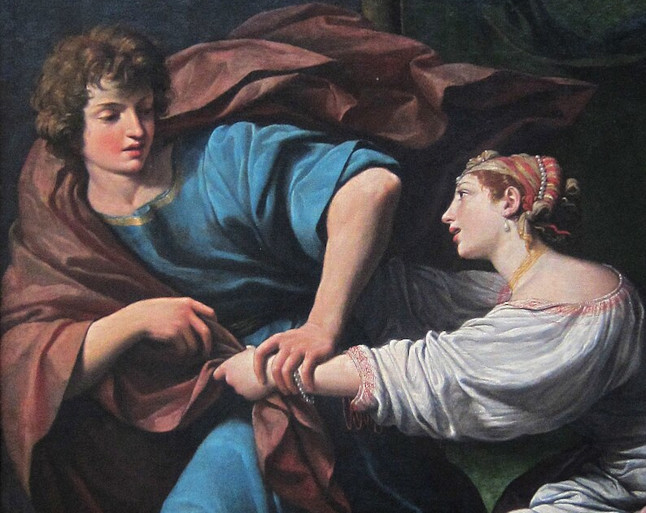
Potiphar's wife puts the moves on our strapping young Joseph, and it reaches the point where she literally tries to drag him into bed with her—but Joseph remains chaste and literally runs away, leaving her with his garment in her grip. Later, she shows her husband that garment and tells him Joseph came in and tried to rape her, and an enraged Potiphar has Joseph tossed in prison.
Repeat after me:
"How can I sin
against God?"
No can do: I love this. One detail of this scene that has long been a powerful inspiration for me personally is the reason why Joseph rejects the advances of Potiphar's wife. Here are a few clues: It isn't because Joseph doesn't find her attractive. Potiphar is basically Egypt's Secretary of Defense, and in ancient Egypt's male-dominated society, a high-ranking officer like Potiphar would have his pick of the most beautiful women in the country. So you can rest assured she's a babe. Her advances aren't just a passing flight of fancy, either...she dogs Joseph relentlessly. And it isn't because Joseph is afraid he'll get caught and get in trouble...they are alone and she makes it clear to him that nobody will ever know about such a discreet little ménage à deux. Joseph tells her the reason why he refuses to touch her in crystal clear terms...and this is a piece of spiritual jerky each one of us would do well to gnaw on whenever we find ourselves faced with temptation. OK, ready? Repeat after me:
"How can I sin against God?"
While in prison, Joseph accurately interprets the dreams of both Pharaoh's cupbearer and baker, and gains a reputation for being able to interpret dreams (Gen. 40). Later, the Pharaoh himself has a pair of dreams, and none of his wisemen or magicians can interpret them (Gen. 41). The cupbearer (who is released and restored to his position in fulfillment of Joseph's interpretation of his dream) finally remembers Joseph, and tells Pharaoh that his former prison pal just might be able to help him with his dreams.
Joseph is summoned to appear before Pharaoh, and Pharaoh recounts his dreams to him. Joseph, who humbly gives all the credit to God, interprets Pharaoh's dreams as foretelling seven coming years of plenty followed by seven years of famine. When he's finished, Joseph urges Pharaoh to appoint a capable person who can wisely manage Egypt's resources and prepare for the coming period of famine.
Pharaoh is so impressed by Joseph and his ability to interpret his dreams that he suddenly realizes that just such a man happens to be standing before him at that very moment:
38Pharaoh said to his servants, "Can we find such a one as this, a man in whom is the Spirit of God?" 39Pharaoh said to Joseph, "Because God has shown you all of this, there is no one so discreet and wise as you. 40You shall be over my house. All my people will be ruled according to your word. Only in the throne I will be greater than you." 41Pharaoh said to Joseph, "Behold, I have set you over all the land of Egypt."
(Genesis 41:38–41)
So in a flash, Joseph is elevated from being an all-but-forgotten prisoner to being the second-in-command of Egypt, second only to Pharaoh himself. God mightily blesses Joseph for his faith and obedience, and does so through the hands of an extremely appreciative Pharaoh.
H-2: God's hands
Sometimes God blesses believers through His own hands, using miraculous or supernatural means. And the reason is simple enough:
Because He can. Why? Because He's God.
And as the story continues in Genesis 42–50 and Exodus 1–12, we see a magnificent example of this unfold.
Under Joseph's supervision, the Egyptians store food during the coming seven good years, and ably prepare for the following seven years of famine. As the famine arrives and engulfs the entire region, Joseph's family is suffering from a lack of food just like everyone else—and they ultimately have no choice but to go to the only place in the region where food is available...
Which, thanks to Joseph, happens to be Egypt.
So they travel to Egypt to purchase food, and in the process come face to face with the kid brother they never expected to see again—and his brothers don't recognize Joseph.
But Joseph recognizes them.
Step by step, Joseph puts his brothers to the test. Step by step, he seeks to gradually bring them to an acknowledgment of their sin and to a place of repentance, and he finally succeeds. At the climax of this testing, he reveals his identity to his brothers and they celebrate an emotional family reunion.
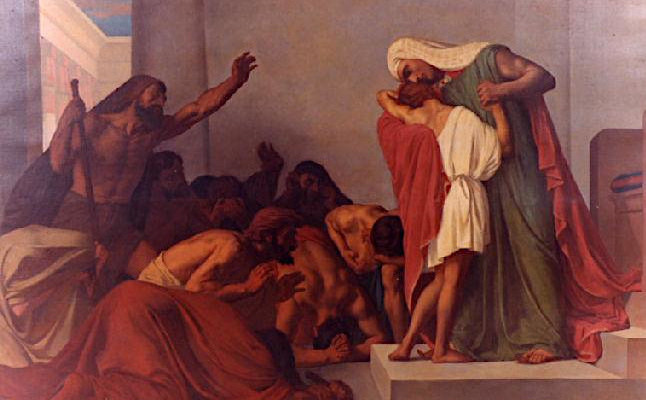
Joseph tells them to bring their father Jacob and the entire extended family to Egypt where they can dwell in safety, and this extended family, in a sense, could be said to represent the seeds of the nation of Israel. They grow and prosper in Egypt; but eventually, after Joseph's death, Egypt finds itself under the rule of a Pharaoh who never knew Joseph.
Over time, things go from bad to worse and the Israelites eventually become slaves in Egypt, toiling under Pharaoh after Pharaoh who know little if anything about what transpired under Joseph. At one point, a Pharaoh takes charge who decides the Israelite population has just grown altogether too large, and decides to order midwives to slay all newborn males among the Israelites. But God sees to it that one survives by being placed in a basket in the river:
His name is Moses.
As a baby, Moses gets scooped up out of the river by the daughter of the Pharaoh, and is raised in royal luxury. But one day Moses witnesses an Egyptian striking an Israelite, and makes the fateful, impulsive decision to kill the Egyptian. When Pharaoh learns of what Moses has done, he orders him to be slain. But Moses escapes and ends up settling in Midian.
One day, God speaks to Moses through a burning bush, and tells him to go back to Egypt and tell the Pharaoh to let His people go and have a feast to worship Him—and Pharaoh refuses. This begins a lengthy, drawn-out process of God blessing His people by delivering them from bondage, and doing it through a series of ten miraculous judgments (Exod. 7–12):
1. Turning the Nile River to blood.
2. An infestation of frogs.
3. An infestation of gnats.
4. An infestation of flies.
5. A pestilence on the livestock.
6. A plague of boils.
7. A brutal hailstorm.
8. An infestation of locusts.
9. Three days of darkness.
10. The death of the firstborn.
And I can hear the skeptics now:
"Miraculous?! Really?! Flies and gnats...ooh, how miraculous is that, huh?"
Many critics, who are determined to explain God away, argue that all this was little more than an unfortunate run of happenstance that befell the Egyptians, and that all ten of these "miraculous" judgments had natural explanations.
Actually, I have no doubt whatsoever that these miracles did have natural explanations. After all, God routinely uses natural means to carry out His will because He has complete control over all of Creation. In other words:
God doesn't need to wave a magic wand and say "Abracadabra!"
Like I said: He doesn't have to—He's God. But one thing such critics are blithely unaware of is the fact that there are significant meanings behind every single one of these ten miracles that profoundly augment those natural explanations, and clearly point to a miracle-working God who is intent on blessing His people by freeing them from bondage, and doing so in a way that utterly destroys the Egyptians' confidence in the bevy of false gods they worship and that undeniably show them that He is indeed the one true God.
What these critics miss is the historical fact that each of these ten judgments is aimed squarely at one or more specific Egyptian deities, and serve to hammer home the point that these false gods are utterly powerless in protecting or benefitting the Egyptian people in any way whatsoever. And at the same time, their utter inefficacy hammers home the point that the God of Israel is indeed the one true God and He is willing and able to bless, protect, and ultimately free what are known to be His covenant people.
So I think it's worthwhile to take a brief look at these ten miraculous judgments and see exactly what Egyptian idols are crushed underfoot.
1. Turning the Nile River to blood.

The Nile was the lifeline of Egypt, and served as the backbone of the Egyptians' economy as well as their daily life. When God causes the Nile to turn to blood, it is a judgment against Apis, Isis, and Khnum—the god, goddess, and guardian of the Nile, resp. This judgment kills millions of fish and renders the waters of the Nile River disgustingly unusable, and shows the highly revered false gods Apis, Isis, and Khnum to be so much meaningless fiction.
Pharaoh is informed of the simple, overarching truth that is one of the fundamental points of the entire sequence of judgments:
"In this you will know that I am the LORD."
It also establishes a pattern that repeats a fundamental truth with thundering clarity over and over again:
I am the one true God, and your worthless
idols are a stinking pile of dung before Me.
2. An infestation of frogs.
This is a judgment against Heqet, the goddess of birth who is depicted with the head of a frog. The frogs invade their homes and die, creating stinking piles of dead frogs throughout the land of Egypt.
3. An infestation of gnats.
This is a judgment against Set, the god of the desert. It's worth noting that God allows Pharaoh's magicians to successfully imitate the first two miracles, but starting with this third miracle of the gnats they're stumped, and truthfully and astutely declare to Pharaoh:
"This is the finger of God."
Prophetic words indeed.
4. An infestation of flies.
This is a judgment on Uatchit, the fly god. Note that no swarms of flies affect the areas where the Israelites live, and so God clearly distinguishes between His people and the Egyptians with this one. Although Scripture doesn't specify as much in every case, the general consensus among commentators is that the Israelites are spared the effects of many of these judgments.
5. A pestilence on the livestock.
This is a judgment on both the god Apis and the goddess Hathor, both of which are depicted as cattle. Again, God protects his people from the effects of this judgment, as only the cattle of the Egyptians die. So God continues to steadily destroy the economy of the Egyptians and shatter their confidence in their idols, all while blessing and protecting His people Israel.
Note that Pharaoh actually sends men out to check whether or not this pestilence is also destroying the cattle of the Israelites. But when they discover that not a single one of the Israelites' cattle has died, all it does is further harden Pharaoh's heart against them.
6. A plague of boils.
This is the first judgment that affects the human body directly, and it is a judgment on three gods related to health and disease: Sekhmet, Sunu, and Isis (also the goddess of the Nile...see #1 above). This plague of boils is so bad that the Bible says Pharaoh's magicians can't even stand before Moses due to their condition (Exod. 9:11).
7. A brutal hailstorm.
Before the next three judgments fall, God lets Pharaoh know they will be more severe, and that they are designed to convince him and his people that there is no one like Him, and so that He can show His power and declare His name throughout all the earth (Exod. 9:14–16).
God even warns Pharaoh to tell the Egyptians to gather whatever livestock remain from the previous judgments in order to preserve them, and some do and some don't. In any event, the hail causes devastating damage to the Egyptians' crops, while the Israelites suffer no ill effects.
This judgment is aimed at three Egyptian gods: Nut (the goddess of the sky), Osiris (the crop fertility god), and Set (the storm god).
8. An infestation of locusts.
Like the previous judgment of hail, this judgment is also an attack on the Egyptian deities of Nut, Osiris, and Set. Grains that mature later like wheat and rye that escaped the effect of the hail are now devoured by swarms of locusts. Thus the Egyptians' harvest for the year is basically wiped out.
9. Three days of darkness.
This judgment is a strange darkness that falls upon Egypt for three days, though Scripture says the Israelites have light in their dwellings (Exod. 10:23).
This is a pointed attack on Ra (also spelled Re), the sun god. Ironically enough, Ra is symbolized by the Pharaoh himself—so this one hits close to home.
10. The death of the firstborn.
Note that the Hebrew word translated "firstborn" (bekor) applies only to males, and in this case Moses indicates that it will apply not only to firstborn sons, but also firstborn animals. What's the big deal about the animals, you ask? For the Egyptians, it means this judgment includes certain animals they worship as deities, which serves to give this tragically grievous knife an extra twist.
This is yet another crushing attack on Isis, the goddess of the Nile, who is also worshiped by the Egyptians as the protector of children.
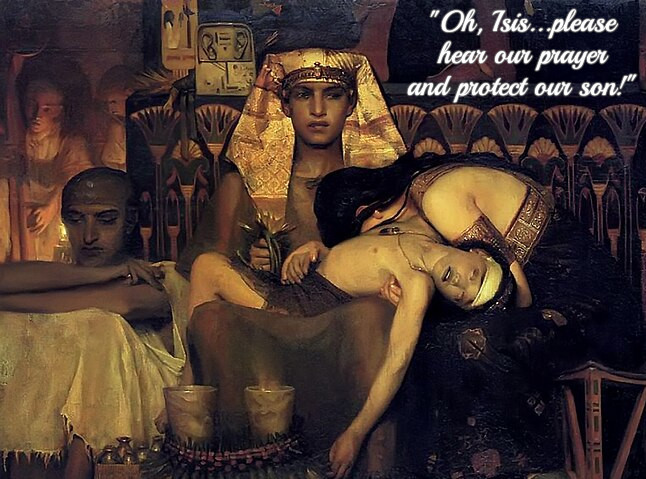
So there can be no doubt that all ten of these miraculous judgments come straight from God's hands, and they serve to bless His people Israel by freeing them from slavery in Egypt.
But God isn't done yet.
This tenth and final judgment affects every single Egyptian household, including that of the Pharaoh himself, who loses his firstborn son.
Note that every Israelite household that follows God's detailed instructions in the sacrifice and consumption of a lamb and the application of its blood to the doorposts of the home is "passed over" by the angel of death, thus giving rise to the celebration of Passover.
They are literally "saved by the blood of the lamb." Sound familiar?
Pharaoh finally crumbles under the weight of this series of divine judgments, and he relents and sends the Israelites packing. And just like that:
They are free.
But they don't get too far before Pharaoh changes his mind and sends his armies after them, and the people of Israel end up being trapped at the banks of the Red Sea. They are keenly aware that Pharaoh's men are rapidly closing in on them, and the God who just blessed them by miraculously freeing them from slavery blesses them yet again by miraculously parting the waters so they can cross safely on dry ground.
After all the Israelites are safely across, Pharaoh's armies show up and follow suit. But at just the right moment, God releases the waters He parted and Pharaoh's men all drown.
Common knowledge: Now, please understand that word about all that God did for the Israelites got around, and so there was no doubt in anyone's mind that the God of Israel had worked quite an impressive sequence of miracles to free His people from slavery and protect them from Pharaoh and his men.
And then they proceed on toward the Promised Land.
H-3: Your enemies' hands
When the Israelites arrive at the threshold of the Promised Land, one of the first things they do is send 12 spies into Canaan to reconnoiter the region (Num. 13–14). When the spies return after 40 days, they all agree that it is a very good land, flowing with milk and honey. However, 10 of the spies are convinced the people living there are powerful giants they can never hope to defeat, living in large, well-fortified cities. They tell Moses they make them look like grasshoppers.
Two of the more faith-filled spies named Joshua and Caleb, however, insist that God has promised them the land. Thus they have confidence that He will go before them and fight for them, and so they tell Moses they should go in and take the land God promised them:
7They [Joshua and Caleb] spoke to all the congregation of the children of Israel, saying, "The land, which we passed through to spy it out, is an exceedingly good land. 8If Yahweh delights in us, then he will bring us into this land, and give it to us: a land which flows with milk and honey. 9Only don't rebel against Yahweh, neither fear the people of the land; for they are bread for us. [Likely a dual meaning—see remarks below.] Their defense is removed from over them, and Yahweh is with us. Don't fear them."
(Numbers 14:7–9 / emphasis & [comments] added)
They are bread for us. Many commentators see a dual meaning here: One meaning is...
• God will enable us to easily defeat them—they are no match for us since God will go before us and will fight for us.
The second meaning is...
• When we defeat them, we will take possession of their fields, their crops, their livestock, their produce, etc.
Or as Pulpit Commentary puts it:
Perhaps it has the further significance that their enemies would be an absolute advantage to them, because they would (however unwillingly) supply them with the necessaries of life.
— Pulpit Commentary [Source]
In other words:
The abundance of Israel's enemies
would become the abundance of Israel.
Incidentally, one might say that Psalm 23, which most commentators attribute to David, also speaks to this idea:
5You prepare a table before me in the presence of my enemies.
(Psalm 23:5a)
Unfortunately, the people are swayed by the negative reports and are sucked dry of their faith in the God who just miraculously freed them and protected them. They rebel against Moses and against God, and are ready to choose for themselves a new leader who will lead them back to good ol' Egypt. As a result, God makes them wander in the wilderness for 40 years until every single one of the men aged 20 or older at the time of their refusal to enter the Promised Land is dead and buried in the desert (Num. 32:11).
Every single one: I've had people look askance at me when I tell them I am convinced from Scripture that every single Jewish person who is not among the believing Jewish remnant that is protected by God in the wilderness will perish by the time the Tribulation ends, and as a result the believing remnant are the only Jewish people who will survive to enter the kingdom. In other words, Paul is quite serious when he says "all Israel will be saved" in Romans 11:26, because they will be the only living Jews remaining when Christ returns to establish that kingdom. I put it to them this way:
"Hey, God did the 'every single one' routine in
the Old Testament...and He's gonna do it again."
But when they finally enter the Promised Land 40 years later, Joshua leads them into the land to conquer the pagan people groups that inhabit it and God is finally able to bless His people through the hands of their enemies. In other words, that's exactly what God does:
He makes the abundance of Israel's
enemies the abundance of Israel.
H-4: Your own hands
As the Israelites wander in the desert for 40 years, God provides a source of food for them: manna. For 40 years, they go out each morning and gather enough manna for one day's food, and no more. The day before the Sabbath, they gather enough for two days to avoid working on the Sabbath.
10The children of Israel encamped in Gilgal. They kept the Passover on the fourteenth day of the month at evening in the plains of Jericho. 11They ate unleavened cakes and parched grain of the produce of the land on the next day after the Passover, in the same day. 12The manna ceased on the next day, after they had eaten of the produce of the land. The children of Israel didn't have manna any more, but they ate of the fruit of the land of Canaan that year. [And they would have to sow and cultivate the fruit of that land through their own efforts from then on.]
(Joshua 5:10–12 / emphasis & [comments] added)
Although you could certainly say that the manna was a miraculous blessing from the hands of God of the H-2 variety, after the Israelites eat their first Passover meal in the Promised Land, that's it. The manna stops. From that day on, they eat the fruit of the land...
Fruit of the land they had to sow,
cultivate, and harvest from then on.
God blesses them by giving them a land flowing with milk and honey, but it will require the work of their own hands to receive that blessing.
Take some time...
Of course, there are countless examples all through Scripture of God blessing those who obey Him, but I thought it would be interesting to discuss the different ways God blesses people in the context of this one extended narrative involving God's relationship with His people Israel.
I know I can certainly list a myriad of ways that God has blessed me during my life using some of these four different sets of hands—and I'm certain that everyone reading this can do the same.
So there's a challenge for you: Take some time to recall how God has blessed you and your family with some of these sets of hands during your lives, and thank Him for every single one that He brings to your mind.
Remember: All born-again believers are members of God's 4-H club...
Especially all those wonderful nerdy farm girls! =;)
Greg Lauer — JUN '26
If you like this article,
share it with someone!

1. Adapted from Sunset Over Grass Field © AOosthuizen (source defunct)
2. 4H Emblem by O.H. Benson, marked as public domain [PD], more details on Wikimedia Commons
3. "Joseph fighting off Potiphar's wife, and she has his garment in her hand" prompt, image generated by DepositPhoto's Nano Banana, SEP 7, 2026
4. "Joseph being reunited with his 11 brothers in Egypt" prompt, image generated by DepositPhoto's Nano Banana, SEP 7, 2026
5. Sea Is the Color of Blood © DEPALL via DepositPhotos
6. Adapted from Death of the Firstborn by Lawrence Alma-Tadema artist QS:P170,Q240526 (text added), marked as public domain [PD], more details on Wikimedia Commons
7. Adapted from 7a–7b:
7a. Click Icon Vector © avastudio via DepositPhotos
7b. "Magnifying glass looking at printed letters ALS" prompt, image generated by DepositPhoto's Nano Banana, JUL 3, 2026
Scripture Quotations:
All Scripture is taken from the World English Bible, unless specifically annotated as the King James Version (KJV) or the American King James Version (AKJV).